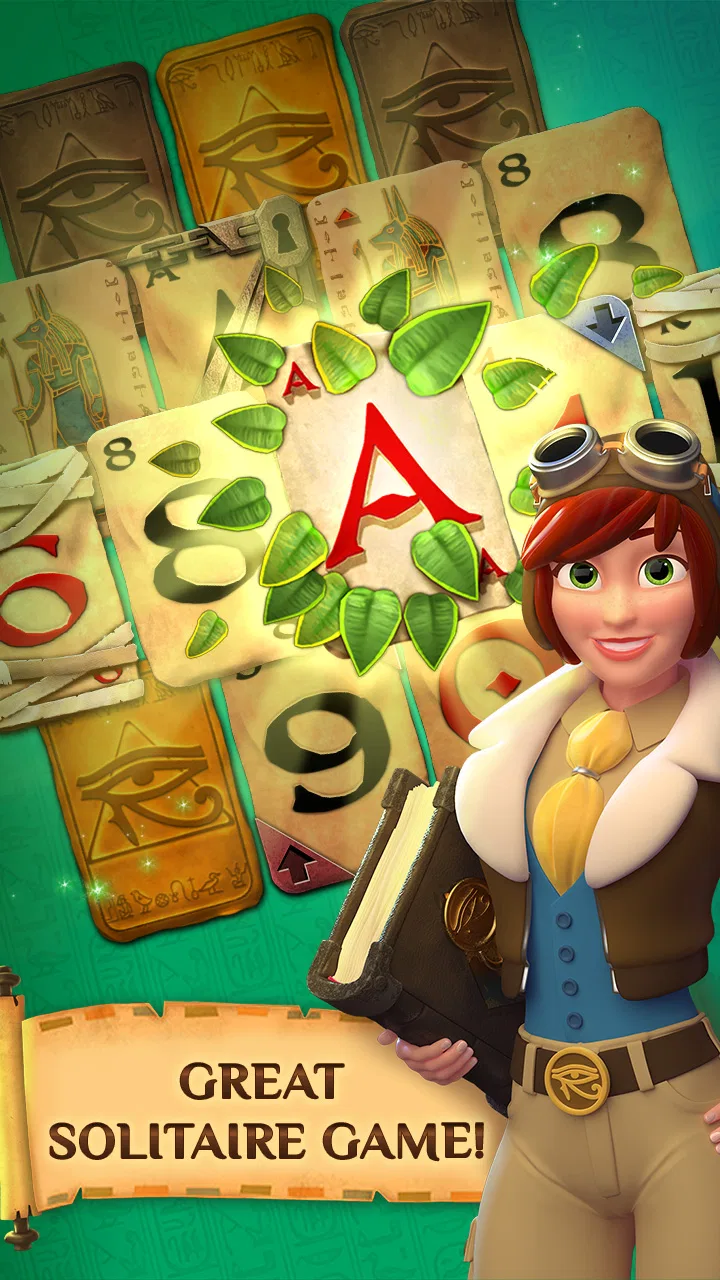
Pyramid Solitaire Saga
- 4.5
- Rating
- 10.00M
- Installs
- Free
- Price

 Analysis by App-foxy
I spent time with Pyramid Solitaire Saga as a relaxed card-puzzle game, and its main appeal became clear quickly: it turns familiar solitaire rules into a series of small strategic challenges wrapped in an ancient-world journey. It is easy to start, but it is not simply a matter of clearing cards as fast as possible. The order in which you remove cards matters, and a careless move can leave the pyramid in an awkward position.
That makes it a good fit for short sessions. I can open it when I have a few quiet minutes, solve a board, and put it down without needing to remember a complicated control scheme. At the same time, the puzzle structure gives me more to think about than a standard deck-based solitaire app. The best reason to try it is the combination of familiar card play and level-based decision-making.
How the card puzzles work in practice
The game is built around Pyramid Solitaire, a variation where cards are removed by pairing them to reach the required total. The pyramid layout creates the tension: cards are covered by others, so the useful move is often not the most obvious move on the screen. I found myself looking beyond the currently available pair and asking which card would open the most important section next.
You May Also Like

 Blood Strike: 2.5 Anniversary
Blood Strike’s Loadouts Turn Every Drop Into a Tactical Gamble
A close look at Blood Strike’s custom loadouts: how fast access to signature weapons reshapes its battle royale rhythm, rewards preparation, and narrows the gap between fights.

 Pandora - Music & Podcasts
Pandora’s Music Is Easy to Start, but Harder to Recover
Pandora’s strength is its low-effort path from a seed to a station. Its weak spot is how much confidence it asks you to place in connection, setup, and quiet recovery.

 8 Ball Pool
 Is Built on Rivalries, Rematches, and Routine
A close look at the rivalries, rematches, shared routines, and unanswered safety questions that turn a quick pool match into a persistent mobile community.

 Samsung Music
’s Quiet Strength Is Playing What You Already Own
Its reach comes less from spectacle than from dependable access to a personal library. That simplicity is both the app’s strongest retention engine and its ceiling.

 AccuWeather: Weather Radar
AccuWeather Review: A Quick, Clear Forecast for Everyday Decisions
For everyday plans, the best forecast is the one you can understand quickly. AccuWeather makes rain timing, radar, and local conditions easy to act on, with a few trade-offs.

 Hill Climb Racing
Why Hill Climb Racing Still Turns Crashes Into One More Run
A tiny car, a bumpy hill and one more upgrade: Hill Climb Racing keeps resurfacing because its simple chaos makes every near-miss feel personal.
More From Our News Desk
View All News


That small change makes the game feel more deliberate than ordinary solitaire. In a traditional Klondike-style app, I usually focus on building suits and moving cards between columns. Here, I am more concerned with uncovering the pyramid efficiently, preserving useful cards, and avoiding a sequence that consumes the options I need later. It still feels approachable, but the central problem is different.
The early experience is friendly because the card rules are quickly understandable. You do not need a long tutorial to recognize what the board is asking you to do. The challenge grows from the arrangement of the cards rather than from a large ruleset. For me, that is an important strength: the game can be enjoyed casually, yet it still rewards planning when the boards become less forgiving.
The ancient setting gives the progression a sense of direction. Instead of feeling like an endless collection of unrelated card layouts, the journey makes each completed stage feel like part of a larger route. I would not choose this game for deep storytelling, but the setting does a useful job of making repeated solitaire boards feel more purposeful.
Why the pyramid layout changes your decisions
The most useful habit I developed was to avoid treating every available move as equally valuable. Removing a pair is satisfying, but the immediate removal is not always the best choice. Sometimes it is better to wait, use a different exposed card, or preserve a card that can connect to several possibilities. This is where the game moves from simple matching into light forward planning.
A practical approach is to scan the pyramid before committing to the first pair you notice. I look for cards that are supporting multiple cards underneath them, since exposing those can create more opportunities than clearing an isolated edge card. I also pay attention to the remaining sequence of available cards rather than assuming a useful card will appear exactly when I need it.
This is one of the less obvious strengths of the game. It rewards a calm pace even though the individual actions are quick. If I rush because a move is available, I can reduce my options. If I take a moment to consider the next two or three consequences, the same board becomes more manageable. That makes it more satisfying for players who enjoy small tactical decisions without wanting a full strategy game.
How it fits into everyday play
A realistic use case is a commute, a waiting room, or a short break when I want something interactive but not demanding. I can play a stage without having to learn a new system each time, and the card format makes it easy to understand the board even when my attention is divided. It also works well as a wind-down activity because the basic rhythm is quiet and repetitive.
There is a trade-off, though. Because the levels are designed around progression, the experience is less suitable if you want completely open-ended solitaire with no campaign structure. Someone who prefers choosing any classic layout, setting a personal time target, and starting another deal immediately may find a dedicated solitaire collection more flexible.
The game is free to download and play, which lowers the barrier to trying it. It also contains in-app purchases ranging from $0.99 to $69.99 per item. I therefore see the free access as the sensible starting point: play enough to decide whether the progression and pacing suit you before spending anything. The available purchase range means the value question depends heavily on how comfortable you are with the way the game presents its optional spending.
I would not describe it as a paid game where the entire experience is clearly exchanged for one fixed price. Its value is instead tied to how much entertainment you get from the free portion and whether you personally want to pay for additional convenience or progression-related options. Since those purchases can vary substantially in cost, I would treat spending as optional rather than necessary for deciding whether the core card puzzles are enjoyable.
Value beyond the basic rules
The strongest value comes from the number of different decisions created by one simple card idea. Matching cards to clear them sounds basic, but the pyramid structure, the available-card sequence, and the need to expose covered cards give each board a practical puzzle layer. I enjoy that the game does not bury its main activity under complicated controls or a crowded interface.
The journey also gives me a reason to return after finishing one board. I am not merely replaying the same type of deal for a personal score; I am moving through a themed sequence of challenges. That sense of advancement can be motivating for players who like visible progress, especially when a short session still contributes to a larger goal.
Another useful quality is its accessibility. The content rating is Everyone, and the minimum operating-system requirement is Android 6.0. That makes the game approachable for a broad range of Android users, including people who are not looking for an intense action title or a complex multiplayer experience. I would still judge the fit by personal preference, but the basic concept does not demand specialized gaming knowledge.
King is the developer, and the game has reached a substantial audience, with over 10 million installs. Its average rating is 4.5 from around 1.1 million ratings, alongside roughly 77 thousand written reviews. Those figures do not replace personal testing, but they do suggest that the combination of casual card play and puzzle progression has broad appeal.
The current version is 1.168.0.0. I mention that because version details can matter when comparing older impressions with the experience available now. The game originally arrived on Jun 30, 2014, so it is an established title rather than a brand-new experiment. That history helps explain why the concept feels polished and immediately understandable.
Where the experience asks for patience
The same progression that makes the game engaging can also become its main source of friction. If I want a pure solitaire session with complete control over the deal and no sense of being guided through a campaign, this is not my first choice. The game is built around moving through its own adventure, so players who dislike structured progression may feel constrained.
The free-to-play model deserves attention before any purchase. Free access is useful because I can test the game without paying upfront, but the presence of individual purchases up to $69.99 means I would avoid tapping through spending decisions casually. My approach is simple: enjoy the free play first, decide whether the core loop remains fun after repeated sessions, and only then consider whether any optional purchase offers enough personal value.
Another limitation is that the game can make a familiar card format feel more goal-oriented than relaxing. I sometimes want solitaire to be a blank, low-pressure space where the only objective is to complete a deal. Here, the level structure encourages me to think about advancement and success conditions. That is motivating for some players, but it changes the mood compared with a minimalist solitaire app.
The game is also not the right substitute for a deeper strategy title. The decisions can be thoughtful, but the rules remain focused and accessible. If I want deck construction, long-term resource planning, competitive matches, or a large role-playing system, I would look elsewhere. Pyramid Solitaire Saga works best when the desired level of complexity is modest and the card puzzle itself is the main attraction.
Small tactics that improve a session
My first practical tip is to inspect the pyramid before using the available cards. I try to identify which exposed card can uncover the largest useful area, rather than automatically taking the easiest pair. This does not guarantee a win, but it reduces the number of moves that leave the important center of the board untouched.
Second, I avoid spending a flexible card too early. A card that can pair with several values may be more valuable later than a card with only one obvious use. When the board offers multiple legal moves, I prefer the one that preserves future choices. This is especially helpful when the next card in the sequence is uncertain or when several covered cards depend on the same exposed section.
Third, I treat failed attempts as information instead of immediately repeating the same sequence. If a particular opening leaves the pyramid blocked, I change the order of the first few decisions. The game becomes more interesting when I use a previous attempt to understand the board’s structure rather than simply hoping for a different outcome.
A fourth tip is to separate entertainment value from purchase pressure. Because the game is free to start, there is no need to decide its full value during the first session. I would play it in several short bursts, notice whether the card puzzles remain enjoyable without rushing, and then make a personal judgment. That approach is more reliable than assuming a purchase will fix a progression pace I do not already enjoy.
Who will get the most from it?
I would recommend it to people who already enjoy solitaire but want more direction than a collection of random deals provides. It is also a good option for casual puzzle fans who like uncovering patterns and making careful choices, yet do not want to memorize a complicated rulebook. The themed journey gives the familiar card format a stronger sense of purpose.
It suits players who enjoy short, repeatable sessions. You can approach a board with a few minutes available, then return later for another attempt. The simple card interaction also makes it approachable for someone who is new to mobile games and wants a gentle starting point.
I would be more cautious recommending it to anyone who wants a completely purchase-free experience, because optional in-app purchases are part of the model. I would also skip it if your priority is competitive play, rich narrative, or a classic solitaire interface with maximum control over game type and layout. Those players may be happier with a traditional solitaire app or a more substantial strategy game.
It is worth noting that the Everyone age rating describes the intended content level, not whether every player will enjoy the progression style. Adults looking for a quiet card puzzle can appreciate it, while younger players may also understand the basic mechanics. The deciding factor is less about age and more about whether the player likes a guided adventure built from solitaire boards.
My recommendation after playing
I see this as a strong free starting point for anyone curious about Pyramid Solitaire with a little more structure than the usual card table. The rules are approachable, the pyramid creates genuine choices, and the adventure setting gives repeated boards a reason to matter. I particularly like the way a simple pair-matching action becomes a question of timing, card preservation, and uncovering the right section first.
My recommendation comes with a clear condition: treat the free version as the test of value, and be deliberate about optional spending. The purchase range runs from $0.99 to $69.99 per item, so I would not assume every available option represents good value for every player. If the free sessions already feel satisfying, the game has earned a place on your device without requiring an immediate purchase.
Compared with a basic solitaire alternative, this offers more progression and a more purposeful puzzle route. Compared with a full strategy game, it is lighter, faster, and much easier to pick up. That middle ground is exactly where it works best. I would install it for relaxed card-puzzle sessions, but skip it if I wanted unrestricted classic solitaire or a completely purchase-free design.
Overall, I think it is worth trying because the central idea is specific enough to stay interesting: clear the pyramid, think ahead, and use each available card with care. It does not need complicated systems to create tension. For me, that balance between familiar solitaire and small strategic decisions is the reason to return, while the structured progression and in-app purchase model are the two things I would consider before committing to long-term play.
FAQs for Pyramid Solitaire Saga
01What is Pyramid Solitaire Saga about?
Pyramid Solitaire Saga is a card game from the makers of Candy Crush Saga. It combines classic solitaire gameplay with a captivating adventure. Players solve challenging card puzzles to uncover secrets and treasures in ancient worlds. The game is designed to be both fun and mentally stimulating, appealing to puzzle and card game enthusiasts.
02Is Pyramid Solitaire Saga free to play?
Yes, Pyramid Solitaire Saga is free to download and play. However, it offers in-app purchases for certain items and game enhancements. While you can enjoy the game without spending money, purchasing these items can enhance your gaming experience by providing extra lives, boosters, or unlocking additional content.
03What platforms support Pyramid Solitaire Saga?
Pyramid Solitaire Saga is available on both Android and iOS platforms. You can download it from the Google Play Store for Android devices and the Apple App Store for iOS devices. The game is designed to run smoothly on most smartphones and tablets with a stable internet connection.
04How does the level progression work in Pyramid Solitaire Saga?
The game features a series of levels, each with unique card challenges. Players must strategically clear cards to advance to the next level. As you progress, levels become more difficult, requiring thoughtful planning and the use of power-ups. Regular updates introduce new levels and challenges to keep the gameplay fresh.
05Can I sync my progress across multiple devices?
Yes, you can sync your game progress across multiple devices. To do this, you need to connect the game to your Facebook account. This allows you to seamlessly continue your adventure on any device by logging in with your Facebook credentials, ensuring your progress is always saved.
Pros
- Engaging levels with unique challenges.
- Beautiful graphics and animations.
- Frequent updates with new content.
- No intrusive ads
- seamless gameplay.
- Easy to learn
- hard to master.
Cons
- In-app purchases can be pricey.
- Requires internet for some features.
- Limited lives can be frustrating.
- Progression can feel slow at times.
- Some levels rely heavily on luck.

Pyramid Solitaire Saga
Gallery